





A Cooperative Housing Project for Indigenous Settlers
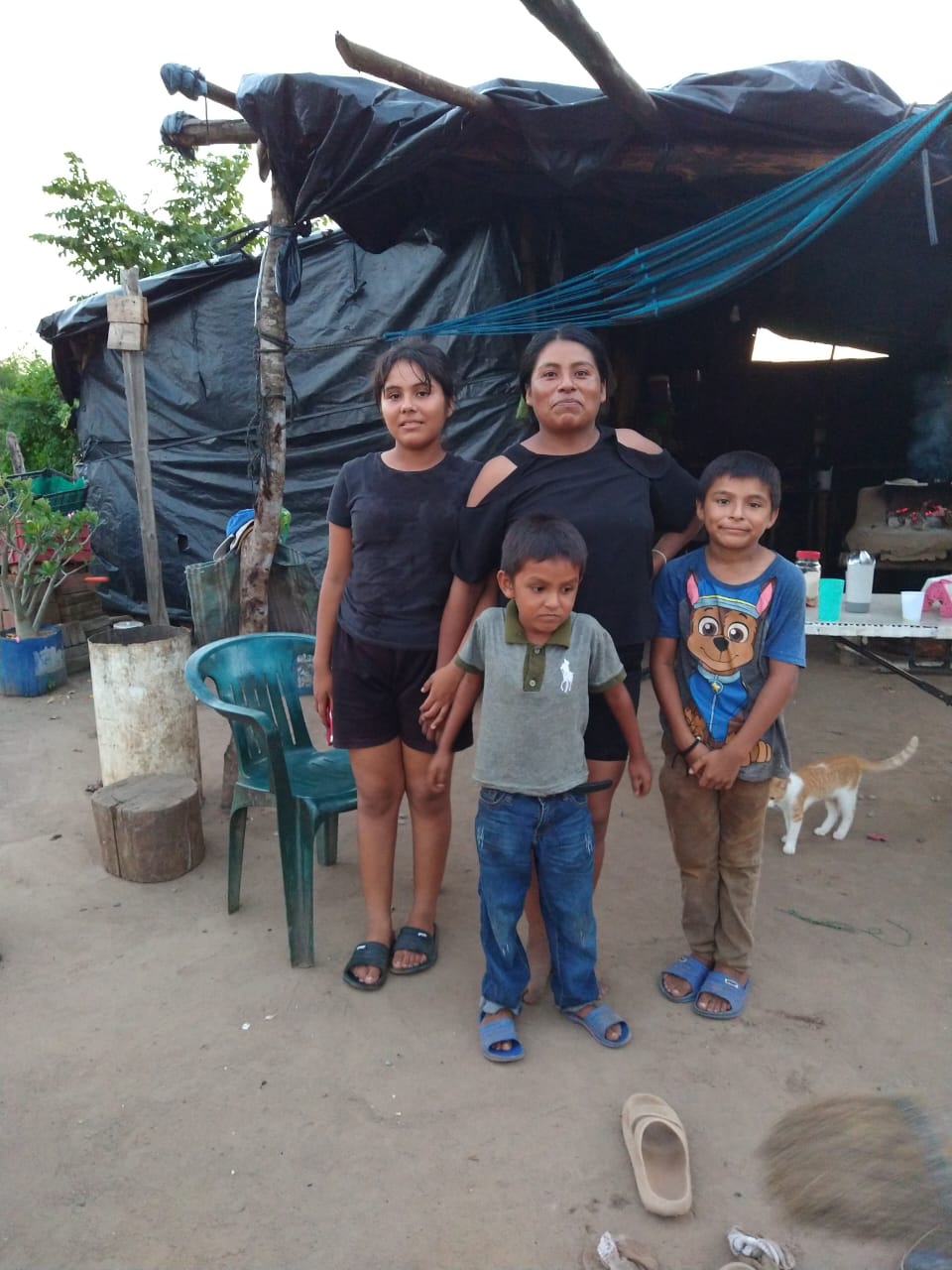
This newsletter describes the collaborative effort by local campesinos in the village of El Tablón Viejo, Sinaloa, Mexico to help meet the urgent housing needs of a number of indigenous families (so-called “indios”) who have settled here in the last few years. These tribal families had been heartlessly forced off their ancestral lands by money-hungry outsiders who wanted their carefully nurtured farmlands to grow drugs on. Hunting for a new place to settle, several of these outcast families have squatted on the outskirts of Tablón Viejo.
As it happens, El Tablón Viejo (the old board)—an hour south of the coastal city of Mazatlán—is the village where my longtime friend Polo Ribota now lives and farms. Likewise, several years ago here in Tablón, Polo built for me an ecologically-friendly adobe house right next to his so that he and his family could help care for me in my old age (I’m now 92) … And, not surprisingly, it was Polo who initiated the humane housing initiative that is the focus of this newsletter.
Polo—a close friend of mine since his childhood—has for decades played an innovative, problem-solving role in PROJIMO, our villager-run disability project in the Sierra Madre.
Polo has long been on the board of directors of our NGO (non-government organization) HealthWrights (Workgroup for People’s Health and Rights). As a hardworking campesino (farmworker), he helps keep us down to earth.
Polo has a big heart and enjoys helping people when they’re down-and-out or treated unfairly. He empathizes strongly with the displaced tribal families who have settled in El Tablón. Perhaps he feels so deeply for these outcast squatters due to his own family’s distressingly comparable history as a child, when drug-related violence killed his father and forced his family into homelessness. So it’s no wonder Polo—now 50 and with children of his own—empathizes deeply with these mistreated indigenous settlers. They share similar harrowing histories. (For more of Polo’s story, see our Spotlight on Polo later in this issue.)
Sadly, this story of systemic ethnic exploitation is a fate shared by many indigenous peoples in the region. In growing numbers, tribal families in the states of Durango, Nayarit, Jalisco, and elsewhere have been forced off their communal lands by opportunistic drugs growers. Because these lands were the first people’s ancestral planting grounds long before Mexico was colonized, there are no recorded titles of ownership. So, with a few pesos passed under the table, the rightful dwellers could be officially evicted. (Efforts are now being made by the current, more justice-oriented Morena government to correct such blatant injustices. But it’s a slow and difficult process.)
From the time a few years ago when these tribal families began to settle in Tablón, Polo has reached out to them in empowering ways: helping them secure squatters rights, water rights, and seasonal jobs as farm-hands. Also, he helped arrange schooling and health care for their children.
However, one of the most pressing needs of these homeland-deprived settlers has been for decent housing. They’d arrived in Tablón with little more than the clothes on their backs. To fend off the blistering sun and pelting rain—with scrounged and scrap material: plastic sheeting, tree limbs, old cardboard, broken tiles, etcetera—they’d ingeniously pieced together makeshift shacks and lean-tos. To follow are a few examples of these makeshift dwellings.
THE SETTLERS HAD DREAMS of gradually improving their living situation. They worked hard—often even the children—but their meager earnings barely covered their most basic necessities.
Then recently, quite unexpectedly, a unique possibility arose: a chance to address some of these displaced families’ most urgent housing needs! It turned out that an elderly longtime friend of HealthWrights, nearing his death, wanted to make a substantial donation to our non-profit organization. He requested that the money he gave make a significant difference to the well-being of disadvantaged people who had been treated unfairly. He wished this could help fund a cooperative venture, with neighbors pitching in for the joy of doing what’s right, not for personal gain. He mused that this example of collective action for the common good might inspire others to give and do likewise.
Because this visionary donor eschewed any publicity for himself, in this newsletter I’ll simply call him “Peter.”
Peter—whom I’d known for many years and is now gone—had a long history of advocating for the rights and social acceptance of maligned and marginalized members of society. When he learned about the plight of the indigenous squatters in El Tablón, he wanted to do something that mattered. As a parting gift, he generously donated US$10,000 through HealthWrights, specifically earmarked to help meet the housing needs of the disadvantaged indigenous settlers in Tablón.
When Polo learned about this unforeseen gift from Peter, whom he knew and liked, he was excited. He met with a number of the indigenous families in greatest need, together with key players and crafts-persons in the village.
The settlers destined to receive improved housing proposed that they collectively build one family’s house at a time, with everyone pitching in. When one house was completed, they’d all move on to help build the next house.
And so it was done.
The US$10,000 donated—converted into roughly 180,000 Mexican pesos—seemed like a lot. But when building houses, even small very basic ones, it can only go so far. So every effort was made to erect safe and functional dwellings, as frugally as possible. The less spent per house, the more could be built.
There were eleven families whose housing needs were most pressing. To build even half that number of modest dwellings with the funds available, clearly the brunt of labor had to be manual and volunteer, with nearly all the money spent on materials.
And so, the home-building marathon was tackled as a community effort. The walls were constructed with locally-made bricks (rather than cement blocks since in the sweltering weather, bricks tend to keep houses a bit cooler than do cement blocks (though blocks are quicker to lay). For the roofs, the team opted for horizontal ones of reinforced concrete. For these, first they had to put up a temporary under-roof of cross beams and planks, rented from a building supply outlet in the city. Upon the planks they laid out a webbing of rebar, over which they poured a 4-inch-thick layer of concrete.
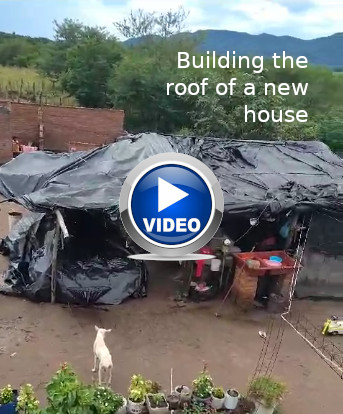
Creating these roofs was a strenuous, labor-intensive job. The team rented a small gasoline-powered cement mixer, the size of a wheelbarrow. In this they made a slurry of powdered cement with sand and gravel hauled from local arroyos.
This slurry, bucketful by heavy bucketful, they hoisted up homemade ladders to the roof—where, skilled local masons with volunteer assistants troweled it evenly over the web of reinforcing rod. After the concrete hardened for a few days, the under-roof was removed and the planks set aside for the next house.
One by one, in this way, the first five new houses went up—fairly quickly and at surprisingly low cost, thanks to so much volunteer labor. Polo sent progress reports and videos to Peter, then under care by hospice, who in his final days, was so impressed that he made an additional donation to build the remaining six most urgently needed houses!
While these houses were very basic, and the brick walls unplastered, they were a huge improvement over the former makeshift hovels. And their collective construction brought not only the indigenous families closer together among each other, but also with the larger, mestizo community.
Sadly, Peter passed away before all the houses were completed. But in his final days he felt happy that he’d been able to partially compensate for the wrongs done to at least a few of the abused tribal refugees. He envisioned that this collective home-building project in Tablón would set an example for other good souls to follow suit.
Note of good will: Currently in Tablón there remain nine tribal families still living in the most inadequate of shacks. Of these, two families are in more dire need than the rest, and could benefit greatly from a basic small house of their own. There is an able workforce of local families who now have their own improved houses, who are ready and willing to collectively help build similar homes for their still hopeful peers. The cost of materials keeps rising—and the relative value of the dollar dropping—but Polo estimates they can currently build a small but livable home for around US$3,500. … If any of you friendly readers have the will and means to help finance an additional house, the recipient family (who would readily help in the construction of their own and similar houses) would deeply appreciate it … as would we. A photo report on the building process and the completed house (or houses) will be appreciatively provided to donors.
Spotlight on Polo
We thought that readers of this newsletter might be interested in knowing something more about Polo (a.k.a. Leopoldo Ribota), who initiated and organized the cooperative housing project described above, and who has played an invaluable role in our health and disability initiative in Sinaloa for decades. So we tell you a bit more about him.
When Polo was seven years old, his family had been forced to abandon their ancestral farmstead deep in the mountains of Durango, and flee for their lives. This sudden, painful displacement was the consequence of a dispute with a powerful drug gang who wanted to take possession of the small airplane landing strip his father had built near their isolated village years before. His father’s resistance to the seizure led to a gun fight in which the lead mafioso was killed. And to save their lives, Polo’s family had to slip away secretly at night, on back trails, with little more than the clothes on their backs. They took refuge in the distant village of Ajoya, in the neighboring state of Sinaloa.
As our long-time friends and readers may remember, Ajoya happens to be the same remote village where Proyecto Piaxtla—the community health program I helped initiate back in 1965—was first based (and where the reconstructed Clinica de Ajoya today is still committed to serving “the last first.” (See our Newsletter #87). It is also the village where PROJIMO (Program of Rehabilitation Organized by Disabled Youth of Western Mexico) grew out of Project Piaxtla in 1981.
When, on fleeing for their lives in 1986, Polo’s family resettled in Ajoya and had to start over from scratch, PROJIMO made an effort to help the newcomers out. Among other things, we invited the uprooted waif Polo to take part in our “children’s toy-making workshop,” where schoolkids volunteered to make developmental toys for children with disabilities. At first, traumatized young Polo was shy and withdrawn, so I personally took him under my wing.
As Polo grew, he became increasingly involved in our rehab activities for disabled children, and developed an uncanny skill at designing and creating assistive devices to meet the challenging needs of individual disabled kids. What he seemed to enjoy most was being helpful to children with the biggest needs. Whenever he wasn’t needed at home, he’d show up at PROJIMO. He learned to make all kinds of assistive devices for disabled persons and liked helping creatively with their therapy. Still in his teens, he developed the patience and innovation of a budding therapist. Yet he was very modest about his skills. When anybody praised him, he’d look away, blushing.
POLO’S FAMILY HAD SETTLED well in Ajoya. They fixed up an abandoned adobe casa, cleared off open land on the mountainside to plant crops, and gradually created a new homestead. For a couple of years things seemed to be going well.
But then tragedy struck again! The same mafiosos who’d been gunning for Polo’s father found out he’d resettled in Ajoya. So once again, the family had to abruptly flee into hiding. I helped them to secretly leave in the middle of the night and to take refuge in a new village: Lodasal. Again, they had to start over from scratch.
But two years later this same dread saga was repeated once again. But this time, tragically, the family fled too late! One night the mafiosos—disguised as state police—kidnapped Polo’s father and with high-speed explosive bullets blew him to pieces. This time the family—what was left of it—ended up in El Tablón Viejo, where they had relatives. (Again, I helped them get there secretly.) For a time they told no one where they’d gone. But we always kept in close touch.
By nature Polo is a gentle, caring person. As long as I’ve known him he has tried to avoid conflict, always ready to help persons in need. He eschews violence – and from an early age recoils at the sight of blood.
But his father’s brutal death had a profound impact on him. His fear of the assassin—a sicario (professional killer) named Don Miguel— turned to hatred, and in the first weeks and months following his father’s death Polo talked more and more about revenge. This was easy to understand. But revenge is a boomerang. I encouraged Polo to look ahead and think of the possible consequences. If he were to avenge himself against Don Miguel, the mafia in turn would seek revenge. This could lead to a circular gyre of violence, which could consume many innocent lives—even his own future children.
Polo and I talked about all this a lot. He was emotionally torn. On the one hand, he wanted a chance to live in peace, without the constant fear that had hounded his family and turned them all into fugitives. On the other hand, he was driven by the festering pain of his father’s murder and the desire for justice.
Polo’s desire for justice/revenge was aggravated by the cultural expectations and peer pressure in a macho society where, too often, ‘might makes right’ and where vengeance can be a measure of manliness. I tried to convince him that restraint can be a strength, and that he should feel positive about his overall kindly, caring disposition.
Polo and I spent many hours cogitating these issues. He seemed glad to have a friendly sounding board to help him sort out the confusing feelings and pressures that pulled him in conflicting directions. What we kept coming back to was the importance of weighing all factors and doing what seemed likely to bring the most happiness and least hurt, especially to those we care for.
As time passed, this mind-breaking situation in some ways improved (though gang violence in the region still continues unabated). (See our Newsletter #89). Within a few years, Polo’s father’s killers—including Don Miguel—were themselves all dead, mostly through inter-gang fighting. So Polo’s family no longer has to run and hide.
TODAY POLO, with his aging mother, his wife and some of his children and grandchildren, continue to live in El Tablón Viejo, where he helps support his extended family—primarily through farming, which he loves. His main crops are chili peppers, tomatoes, and cucumbers. These he grows in quantity, for sale.
In addition to cultivating these basic vegetables, Polo—planning ahead—over the years has planted and nurtured a sizable orchard of mangos. His hopes are that as he grows older and less able-bodied (he is now 50), these long-lived trees will produce an increasingly large crop, presumably with a diminishing need for maintenance. (As the root system expands in bigger trees, less watering tends to be required.)
Likewise, Polo has long been thinking ahead about my advancing old age. As I mentioned earlier in this newsletter, back in 2005, next to his modest house on the outskirts of El Tablón, he and his family built an attractive thoughtfully designed, home for me, so that they can help care for me in my declining years. With walls of extra thick adobe bricks to insulate against the scorching seasonal heat, and with features to accommodate both my progressive physical disability and advancing age (I’m now 92), the building is both ecologically friendly and relatively cool in hot weather. When in Mexico I’ve been residing primarily in this wonderfully personalized home in Tablón, so thoughtfully adapted to my needs, and aided by a family that cares for me—in every sense.
Now for more than 40 years, Polo and I have been closest friends. Currently he helps me far more than I help him. When I’m in Mexico, and when he occasionally visits to the United States, he assists me as my personal attendant (along with Carlos – see our newsletter #89). He gladly helps me with bathing and personal hygiene. He helps me put on my full-leg orthopedic braces. And mornings and evenings, he goes walking with me, carefully supporting my arm and shoulder on one side while I do my best to support myself with a walking stick on my other side. For these walks, he often takes me to a beautiful natural setting, or to a path that he carefully cleared and leveled on his farmland. He helps keep me alive – and glad to be so.
Over the years Polo has been an enormous help in our village-based rehabilitation program (PROJIMO). He has repeatedly driven carloads of disabled children from Sinaloa to California for (freely provided) care and surgery at Shriners Hospital, and elsewhere. And he has consistently reached out with help and friendship to those in greatest need.
In sum, Polo has for decades played an exceptional, deeply caring role, both for the community health and rehabilitation programs he became a part of, for the well-being of villages he has lived in and reached out to. He has been my colleague and my devoted personal friend for decades. And increasingly now in my declining years, my unflagging and uplifting care provider.
Understandably, Polo still carries deep emotional scars. But—perhaps for all he’s been through over the years—he also has a relentless empathy for others who have been treated cruelly and unjustly. A good soul.
Announcing an exciting new book: The Art and Odyssey of David Werner: A 90 Year Adventure
David Werner has been working with Jason Weston on an art book presenting his paintings, drawings and sketches over the last 70 years. Many of the pictures are in full color. The volume also includes the stories behind those illustrations that portray more telling and transformative events in his rather atypical life. Through the years, David has tried his hand at sundry different genres of painting and illustration—the full range of which is represented on these pages. A strong influence on his style was the training he received in sumi-e by a Zen artist in Kyoto, Japan. For several years his painting reflected this Asian influence—and his technique was largely restricted to black and white charcoal brush painting. But as he began to paint more birds and flowers, he began experimenting with gouache watercolor. The illustrations in his previous books, however, are almost completely black and white line drawings. Examples of all of these styles—and others, including charcoal stick sketches done as a youth in Paris—are included in this book. Caption: Many of the pictures in the art book, like this one, depict David’s humanitarian philosophy.
This collection also includes a selection of autobiographical drawings from the cornucopia of David’s life, including an extraordinary trip by bicycle to India. A good number of these drawings are in fact illustrations for his upcoming three-volume autobiography. In deciding to include these illustrations, rather than just using brief captions, in many cases he decided to include the full associated story. Because he decided to make drawings of the most dramatic, challenging, and soul-changing events of his life, the accompanying stories add a lot of power and meaning to the pictures. While the inclusion of stories like these are unusual in a book of visual art, the authors felt that the stories behind these autobiographical drawings contribute so much more meaning to them that it deserves breaking with convention. While most of the pictures in this book are graphic art, the volume ends with a few photographs of buildings (mainly tree houses) David designed, and a wood carving that he hewed.
All in all, the content and presentation of this art book is a bit unconventional, as indeed has been David’s long and eventful life.
We hope to have the book in print within the coming months. We’ll send out an announcement at that time. So keep an eye out—and we hope you enjoy it.
End Matter

| Board of Directors |
| Barry Goldensohn |
| Bruce Hobson |
| Jim Hunter |
| Donald Laub |
| Leopoldo Ribota |
| David Werner |
| Jason Weston |
| Efraín Zamora |
| International Advisory Board |
| Allison Akana — United States |
| Dwight Clark — Volunteers in Asia |
| Mira Shiva — India |
| Michael Tan — Philippines |
| María Zúniga — Nicaragua |
| This Issue Was Created By: |
| David Werner — Writing, Photographs, and Drawings |
| Jason Weston — Editing and Layout |